How Much Soil Does a Raised Garden Bed Need?
Figuring out how much soil you need for a raised garden bed can seem tricky, but it’s straightforward once you know the right calculation.
Typically, you’ll multiply the bed’s length, width, and depth to find the total cubic feet of soil required.
For example, a four-by-eight bed that’s 12 inches deep needs about 32 cubic feet of soil.
Keep reading to learn how to get your soil just right for your garden’s needs.
Calculate Your Raised Bed’s Soil Volume: Length × Width × Depth
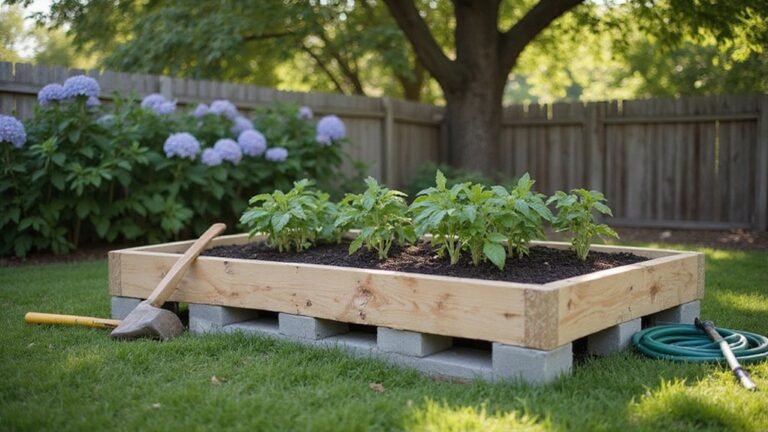
To calculate your raised bed’s soil volume, multiply the length, width, and depth. Measure your bed’s length and width in feet, then convert the depth from inches to feet by dividing by 12. For example, a bed that’s 6 feet long, 4 feet wide, and 6 inches deep will have a volume of 6 × 4 × 0.5, which equals 12 cubic feet. Knowing the soil volume helps you determine how much soil to order or prepare. For bulk purchases, divide that cubic footage by 27 to convert to cubic yards—in this case, approximately 0.44 cubic yards. It’s a good idea to order about 10% extra soil to account for settling and compaction over time, ensuring your bed remains fully filled as the soil naturally settles. Consider repurposing a sturdy outdoor structure to protect your soil from excessive rain or animals, similar to how a well-designed coop shelters a flock, and this structure should provide sufficient space for easy access and maintenance. When storing excess soil or amendments, be aware that glass mason jars can crack if frozen while full of wet material.
Raised Bed Depth Requirements: 6 Inches for Greens, 12 for Tomatoes
Matching the bed depth to your plant type is essential. Greens like lettuce, spinach, and Swiss chard thrive in 6 inches of soil because their roots are shallow and grow quickly. This depth provides enough space for roots to develop without crowding, supporting rapid growth and easier management of planting schedules. Additionally, thinner beds dry out faster, reducing moisture-loving pests such as slugs. While repurposing egg cartons for seed starting fits the homesteader mindset, their cardboard material is widely recyclable as long as it is clean and free of food residue. For optimal health, roosting bars for chickens should also be placed at consistent heights to prevent injuries and ensure comfort. Choosing the right watering can near me ensures consistent moisture for these shallow-rooted greens.
For tomatoes, a minimum of 12 inches of soil is necessary. This deeper bed supports robust root systems, which help the plants resist drought and increase fruit production. Peppers, beans, and cucumbers also benefit from this depth. Keep in mind that you’ll need about 1 cubic foot of soil per square foot of planting area for these crops. Going shallower can limit growth potential and reduce yields, so always match your bed depth to the specific needs of each plant for optimal results.
Rectangular Bed Soil Estimates for Common Sizes (4×4, 4×8)
To calculate the soil volume for your rectangular bed, start by determining the dimensions and desired depth. For a 4×4 bed at 6 inches deep, you need about 8 cubic feet of soil, which translates to roughly 4 standard bags. If you increase the depth to 12 inches, the volume doubles to 16 cubic feet, requiring 8 bags. For a 4×8 bed at 6 inches deep, you also need 16 cubic feet, while at 12 inches, that volume doubles again to 32 cubic feet, meaning 16 bags are necessary. Consider how raised bed garden layouts can affect your space and growth efficiency. Alternatively, you can buy bulk soil, which is often more cost-effective for larger quantities. For example, a 4×8 bed at 12 inches deep needs approximately 1.19 cubic yards of soil, costing between $80 and $160. Planning your soil needs ahead of time ensures you have enough to complete your project and helps you coordinate pest control and planting schedules efficiently. Using hardware cloth as a bottom barrier can prevent burrowing pests from entering your raised bed.
How to Calculate Soil for Hexagonal and Octagonal Raised Beds
To calculate the soil needed for a hexagonal or octagonal raised bed, start by measuring all dimensions accurately in feet, including side length and depth. For a hexagon, use the volume formula V = (3/2) × √3 × s² × h, where s is the side length in feet and h is the depth in feet. For an octagon, apply V = 2 × (1 + √2) × s² × h, with the same unit considerations. Once you have the volume, add an extra 10% to account for settling and compaction, ensuring your plants have the root space they need. For example, a hexagonal bed with a 4-foot side and 1-foot depth requires approximately 2.1 cubic feet of soil, while an octagonal bed of the same size needs about 3.9 cubic feet. Always double-check your measurements and include the additional buffer before ordering soil. If your soil becomes too wet or dense, it may develop compost bin smells that indicate poor aeration.
Bagged Soil Under 54 Cubic Feet; Bulk Delivery for Larger Orders
For soil orders under 54 cubic feet, bagged soil is the most convenient and precise option. Standard bags are typically 0.75 cubic feet, making it easy to calculate how many you need for smaller beds. You’ll pay between $4.00 and $8.00 per bag, which helps prevent waste and keeps soil contamination from unknown sources out of your garden. Additionally, this allows you to select specific organic amendments tailored specifically to your plants’ needs. For those raising Silkies, you might also consider a chicken coop designed to integrate with your garden setup.
Once your order exceeds one cubic yard, which is about 54 bags, switching to bulk delivery becomes more cost-effective. Bulk delivery can reduce your costs by 40% to 60%, with prices generally ranging from $30.00 to $50.00 per cubic yard. This compares favorably to $60.00 to $100.00 for small bagged quantities. Before scheduling bulk delivery, you need to ensure a clear access path of at least 10 feet wide and 12 feet high for the delivery truck. While you lose the ability to control individual bags, you gain significant savings and can still incorporate organic amendments into the soil before filling your beds. Bulk delivery also helps decrease plastic waste from numerous bags, making it a more environmentally friendly choice.
The Ideal Soil Mix: 40% Topsoil, 40% Compost, 20% Sand
The ideal soil mix is 40% topsoil, 40% compost, and 20% sand. This ratio provides a balanced foundation for healthy plant growth. The topsoil supplies minerals and structure, supporting root stability. Compost offers a rich source of nutrients that promote vigorous development. The 20% sand enhances drainage and improves root aeration, preventing waterlogging. Using this mix makes watering more forgiving. Water penetrates evenly, reducing the risk of roots sitting in excess moisture. To keep the soil evenly hydrated without compaction, an antique brass watering can offers gentle and precise watering. For efficient irrigation, a ceramic watering can planter can also serve as a dual-purpose tool that maintains soil moisture levels. The loose texture allows roots to breathe freely, encouraging strong development. You are likely to see healthier crops, such as tomatoes and peppers, flourish. To create this mix, layer the components in 6-inch increments and mix thoroughly until uniform. For additional versatility, consider using pressure treated lumber to build durable raised bed frames that resist rot.
Step-by-Step Example: From Bed Measurements to Your Soil Order
To determine how much soil you need for your bed, start by calculating the volume based on its dimensions. For example, if your bed measures 4 feet long by 8 feet wide and you want a depth of 18 inches for optimal tomato growth, convert all measurements to feet. The height of 18 inches equals 1.5 feet. Multiply the length by the width by the depth: 4 x 8 x 1.5 equals 48 cubic feet. This is the total soil volume required. For properly sealing amendments and storing excess soil, you might consider using a vacuum sealer for mason jars to keep your mix fresh and dry.
Next, convert cubic feet to cubic yards because soil is usually sold by the yard. Divide 48 cubic feet by 27 (since one cubic yard equals 27 cubic feet), which gives approximately 1.78 cubic yards. To account for compaction and settling, add about 10 percent, bringing the total to roughly 2 cubic yards. Always round up to ensure you have enough material.
Before ordering, it’s also wise to conduct soil testing to balance nutrients for optimal plant health. Consider selecting mulch options as well; mulch helps retain moisture and reduces washout from watering or rain. Fill your bed with the appropriate mix of soil components, and you’ll be set for planting your tomatoes successfully.